
ERDE news
Making circularity work on the ground: A practical case from the ERDE system
Managing agricultural plastics remains a practical challenge across Europe. Materials such as silage and stretch films, nets and twines are essential for modern farming, yet their collection and recycling often depend on well-functioning local structures. Practical examples therefore provide valuable insight into what enables circularity “on the ground”. A concrete example can be found in the ERDE system in Germany.
The German ERDE initiative (Erntekunststoffe Recycling DEutschland) is a nationwide recovery and recycling system for agricultural plastics. ERDE is organised under the umbrella of the IK Industrial Association for Plastic Packaging and managed by RIGK. It is a voluntary, industry-led scheme that combines manufacturer financing with decentralised collection structures and established recycling pathways. Its effectiveness becomes particularly visible at local level.
A practical case: collection organised through contractors
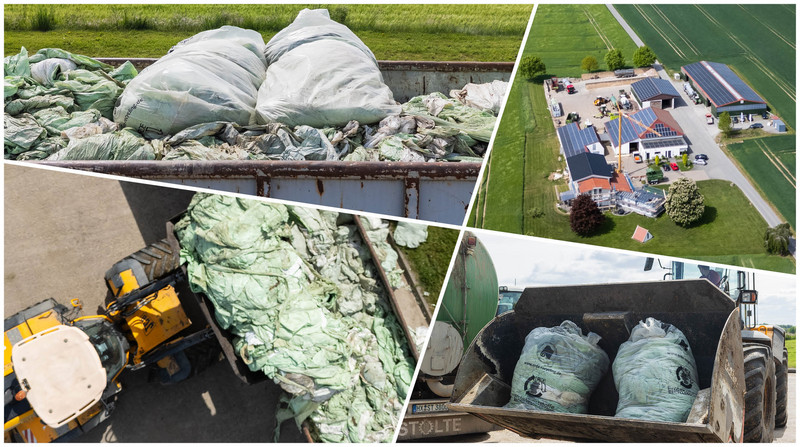
A visit to the contracting company Stolte in Willebadessen, Germany, illustrates how the system works in practice. On collection days, farmers deliver used agricultural plastics – such as silage and stretch films or nets – already sorted by material type. On site, the materials are received, consolidated and prepared for transport to recycling facilities.
Contractors play a central operational role. They organise collection points, coordinate logistics and communicate directly with farmers. Their understanding of everyday agricultural practice enables efficient organisation and high participation rates. Cooperation with contractor networks, such as the German Association of Agricultural Contractors (BLU), further strengthens this approach by embedding collection activities within existing agricultural structures.
Participation depends on proximity and communication
The Stolte example highlights two key success factors: accessibility and communication. Farmers report that short distances to collection points and clearly communicated collection dates are decisive for participation. In practice, contractors increasingly rely on direct communication channels, including digital tools, to inform their customers. Where information is timely and processes are straightforward, returning used plastics becomes part of routine farm operations.
This local perspective reflects the broader system design: according to ERDE figures as of 2026, ERDE operates more than 700 collection points and works with over 160 partners, ensuring wide coverage and practical accessibility.
From collection to recyclate
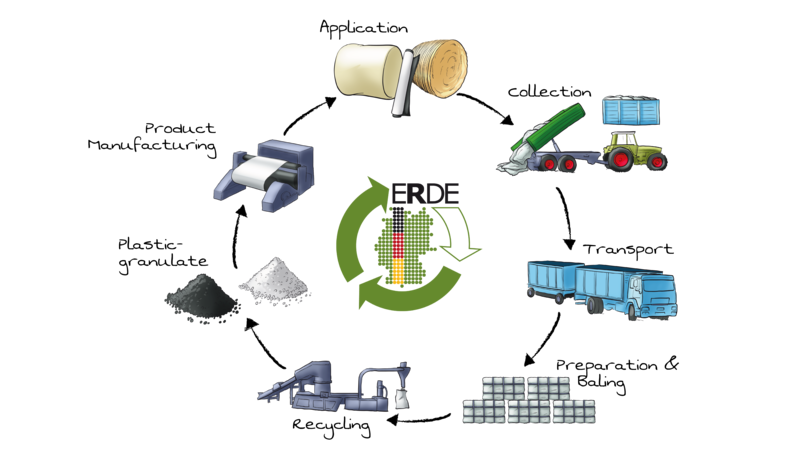
Once collected, the materials are processed by specialised recycling partners. A prerequisite for efficient recycling is proper sorting: separating films, nets and twines improves material quality and enables higher-value recyclate applications. This structured approach allows agricultural plastics to be reintroduced into production as secondary raw materials, moving beyond waste management towards a functioning material loop.
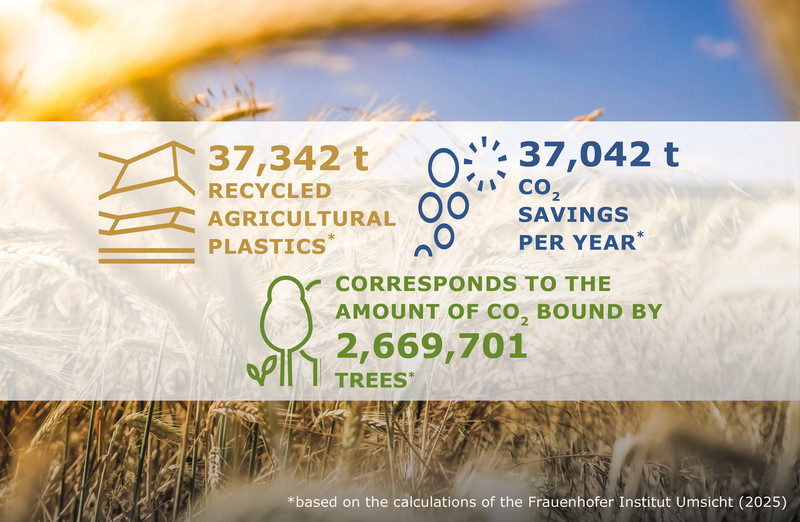
The practical implementation translates into measurable outcomes. According to ERDE’s 2025 figures, 37,342 tonnes of agricultural plastics were collected and recycled within the ERDE system. This resulted in greenhouse gas savings of approximately 37,042 tonnes of CO₂ equivalents. The results clearly show that the ERDE system works in practice when all actors along the value chain are aligned.
From practice to transferable learnings
The Stolte case also points to broader lessons for agricultural plastics recycling:
- Use existing structures: integrating contractors and agricultural trade reduces complexity and increases reach.
- Ensure proximity: dense and accessible collection networks drive participation.
- Keep requirements simple: clear sorting rules improve material quality and recyclability.
- Communicate directly: timely, practical information is key to user acceptance.
These elements are not specific to one country; they can inform system design more widely.
European exchange and outlook
The importance of practical experience is reflected in increasing international exchange between collection schemes. At the European National Collection and Recycling Schemes Meeting in Irsee, Germany, on 19–20 March, stakeholders from across Europe discussed operational approaches and shared best practices. The dialogue highlights a common understanding: effective circular solutions for agricultural plastics depend less on theoretical models and more on reliable implementation.
The ERDE system demonstrates that circularity in agriculture can be achieved through well-organised, practice-oriented approaches. The example of contractor-based collection shows how local structures, clear roles and effective communication translate into a functioning recycling system. As a practical case, it provides concrete insights into how agricultural plastics can be managed in a circular way – and how similar systems could be developed and adapted across Europe.
Contact:
Initiative ERDE / RIGK GmbH
System Manager Boris Emmel
emmel@rigk.de
+49 611 308600‑20